

URL: https://sflash.desy.de/@@siteview
Breadcrumb Navigation
An experiment at FLASH for a seeded EUV-FEL
Free-electron lasers (FEL) utilize high-relativistic electron beams to generate X-ray radiation in undulator magnets. Spontaneous undulator radiation emitted by the electron beam leads to an exponential growth of the radiation intensity in a self-amplification process (SASE). The stochastic nature of the spontaneous radiation leads to shot-to-shot fluctuation of the spectral properties of the FEL radiation. A way to overcome these fluctuations is the so-called seeding of FELs. Either an external light field acts as a direct seed for the FEL amplifier or the inner structure of the electron bunch is manipulated by external lasers such that an initial microbunching drives the FEL process. The harmonic content of the microstructure allows to radiate at higher harmonics of the initial laser wavelength.
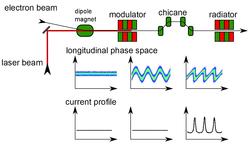

Principle of high-gain harmonic generation
Presently, an experiment for High-Gain Harmonic Generation (HGHG) is under investigation at the free-electron laser facility FLASH. The working principle is depicted in the image above. The goal is to test this mode of operation for the special beam parameters of FLASH. In collaboration with the Technische Universtität Dortmund, experiments with new operation schemes (EEHG) are under investigation which enable radiation of even higher harmonics of the seed wavelength.

